
Dental sealants are a thin, protective dental coating painted onto the chewing surfaces of the back teeth to seal out food, plaque, and bacteria before cavities can start. The treatment is quick and painless, and one application can protect teeth for several years, with some sealants lasting up to nine years when they are checked and touched up at regular visits. Dental sealants are used most often for children up to age 14, because the first permanent molars come in around age 6 and the second molars around age 12. At Little Smiles of Beverly Hills, Dr. Sepehr Nassiripour places dental sealants for kids in his Beverly Hills, California office, using a gentle approach with no needles and no drilling.
Cavity Protection
Seals deep tooth grooves
Painless Treatment
No needles, no drilling
Long-Lasting Defense
Protects for several years
Quick Visits
Just minutes per tooth
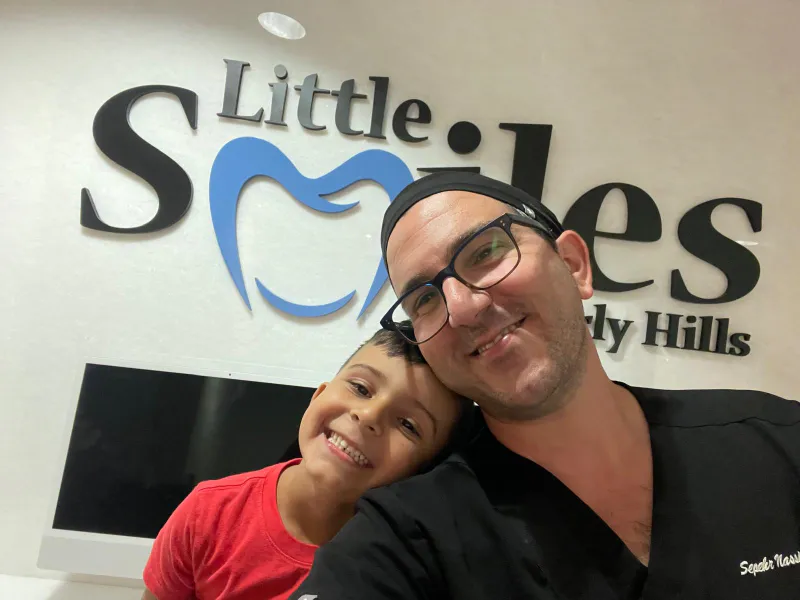
DR. SEPEHR NASSIRIPOUR
If you have ever asked, “What are dental sealants?”, here is the short answer. A dental sealant (also called a tooth sealant or fissure sealant) is a thin protective coating for teeth that works like a raincoat for your child’s molars.
Back teeth are bumpy, with deep pits and grooves. Even a good toothbrush can’t reach all the way in. Food and bacteria settle there, and that is where most childhood cavities begin. According to the CDC, about 9 out of 10 cavities in children happen in the back teeth. A sealant fills in those grooves so there is nowhere left to hide.

The CDC focuses only on children’s dental carereports that sealants prevent about 80% of cavities in the back teeth for two years after placement, and still protect against about 50% of cavities for up to four years.

School-age children without sealants have almost three times more cavities than children with them.

The American Dental Association (ADA) and the American Academy of Pediatric Dentistry (AAPD) have a joint guideline recommending sealants for the chewing surfaces of baby and permanent molars in children and teens.

Many parents are surprised to learn that sealants on baby teeth can be a smart choice. Baby molars may be temporary, but they have important jobs. They help your child chew, speak clearly, and hold space for the adult teeth underneath. A cavity in a baby molar can cause pain and infection, and it can lead to early tooth loss.
The ADA and AAPD guideline covers both baby and permanent molars. Because baby teeth have thinner enamel, a protective tooth coating can be especially helpful when the grooves are deep or when your child is prone to cavities. Dr. N examines each baby molar and only recommends a sealant when it will truly help. If your child’s baby teeth are already decayed, we’ll talk through other options, such as Silver Diamine Fluoride (SDF) or Pediatric Zirconia Crowns.
PATIENT REVIEWS
Looking for dental sealants for your child in Beverly Hills? Little Smiles of Beverly Hills is a pediatric dentist in Beverly Hills that focuses on children’s dental care. Dr. Sepehr Nassiripour sees families from across Beverly Hills and nearby Los Angeles communities, including Culver City.
We make sealants easy for busy California families:
Many families first meet us at a routine checkup. If we see that your child’s new molars could use extra protection, we’ll explain why and let you decide how to move forward. Call us or book online to ask about pediatric dental sealants in Beverly Hills.
Dental sealants have been used for decades, and they are supported by the American Dental Association (ADA) and the American Academy of Pediatric Dentistry (AAPD). Some parents ask about BPA, a chemical found in some plastics. At Little Smiles of Beverly Hills, Dr. Sepehr Nassiripour uses BPA-free sealant materials. The ADA also notes that the tiny amount of exposure possible from sealants is far lower than what we get from everyday sources, and that the risk of untreated tooth decay is much greater. You can read more on the ADA’s MouthHealthy sealants page.
A dental sealant is a small investment in prevention. It usually costs far less than a filling, and a filling is not as strong as natural enamel and may need to be replaced over time. Deeper decay can lead to crowns or root canal treatment, which are more costly and more invasive for a child. Many dental plans cover sealants for children and teens, so call your insurance company or our office and we will help you check your benefits.
Sealants typically last several years, and the CDC notes they can protect teeth for up to nine years. Hard or sticky foods, like ice, hard candy, and caramel, can chip or loosen the dental coating, so it helps to limit them. We check your child’s sealants at every visit and add more material when needed. Remember that a sealant covers only the chewing surface. Brushing twice a day with fluoride toothpaste and flossing daily are still important to protect the spaces between teeth and the gum line.
Drills and fillings can be scary for young children, and a frightening early experience can make some kids nervous about the dentist for years. Because sealants help prevent cavities in the first place, many children need fewer fillings and can see the dentist as a place for simple checkups and cleanings. That builds trust, which makes every future visit easier for your child and for you.
The sooner the better, because a sealant works best on a tooth that has no cavity yet. Sealants for children’s molars are most helpful soon after the teeth come in. The first permanent molars usually appear around age 6, and the second molars around age 12. That is why we focus on children under 14.
Yes. Sealants have been used for decades and are supported by the ADA and AAPD. We use high-quality, BPA-free materials trusted by pediatric dentists.
No. A sealant covers the chewing surface only. It does not protect the spaces between teeth or the gum line, so brushing twice a day, flossing, and regular checkups still matter.
Not every child needs them on every tooth. They help most when molars have deep grooves or a child is prone to cavities. Dr. N checks each tooth and tells you honestly whether sealing is worth it.
A sealant flows into the deep grooves of a molar and hardens into a smooth, protective layer. That seals out food and bacteria, so the grooves can’t trap them. It is a simple way to seal and protect dental surfaces that are hard to clean by brushing alone.
Yes. Most sealants are made of a thin, tooth-colored resin, which is a type of dental plastic. It bonds to the tooth, does not change how the tooth looks or feels in any noticeable way, and is not a filling, because nothing is drilled away.
No. There are no needles and no drilling. Most children say it feels like having their teeth painted and dried.
We don’t recommend it. Over-the-counter products are not the same as the professional materials used in a dental office. A real sealant needs a clean, dry tooth and a special curing light to bond properly. If it isn’t placed correctly, food and bacteria can get trapped underneath, where you can’t see them.
No. A sealant can’t be done safely or properly at home. If your child has deep grooves or you are worried about cavities, book a quick visit and we will check which teeth would benefit.
Ultradent is one of several dental companies that make sealant materials. At Little Smiles, Dr. N chooses a high-quality, BPA-free sealant that pediatric dentists trust. If you’d like to know the exact product, just ask our team at your visit.
Dental sealants for kids are made to prevent cavities in the chewing surfaces of molars. They are not a treatment for tooth sensitivity. Some products, sometimes called a dental coating for sensitive teeth, are meant for exposed tooth surfaces and are mostly used in adults. If your child complains that their teeth are sensitive to cold, hot, or sweet foods, it can be a sign of a cavity or weak enamel, so please schedule an exam rather than guessing.
The ADA says sealants often last several years, and the CDC notes they can protect for up to nine years. Chewing and grinding wear them down over time, so we check them at every visit and touch them up when needed.
Many dental plans cover sealants for children. Call your insurance company or our office and we’ll help you understand your benefits.
Dental sealants are used most often for children up to age 14, and that is our main focus at Little Smiles of Beverly Hills. But prevention has no age limit. Adults with deep grooves in their back teeth, who have no decay or fillings in those molars, can also be good candidates for teeth sealants. If you are an adult interested in sealants, ask Dr. Sepehr Nassiripour whether they make sense for you.
A few minutes in the chair today can save your child from years of cavities, fillings, and discomfort. We would be honored to help you protect their smile.


