As a pediatric dentist here in Beverly Hills, I have the privilege of meeting wonderful families every day. Parents want the absolute best for their children, from the schools they attend to the food they eat. Naturally, this level of care extends to their healthcare. One of the most common questions I hear in my exam room usually comes with a look of concern: “Dr. Nassiripour, are these X-rays really safe for my child?”
I completely understand this hesitation. As a parent myself, I know the instinct to protect your child from anything that seems unnecessary or potentially harmful. The idea of radiation, no matter how small the dose, can feel scary. However, I want to take this opportunity to have an open, honest conversation about pediatric dental x-rays safety. My goal is to explain why we use them, how technology has changed, and the rigorous safety standards we follow to ensure your child’s smile remains healthy and bright.
Why Do We Need X-Rays in the First Place?
You might wonder why a visual exam isn’t enough. When I look inside your child’s mouth, I can see a lot. I can check the surfaces of the teeth, the health of the gums, and how the jaws are aligning. However, visual exams have limits. There are hidden areas in the mouth that the naked eye simply cannot access.
Dental X-rays, or radiographs, are essentially my superpowers. They allow me to see:
- Decay between teeth: This is the most common place for cavities to hide. By the time a cavity between teeth is visible to the eye, it is usually very large and may need extensive treatment.
- Bone health: X-rays help me evaluate the bone that supports the teeth, checking for any loss due to gum disease or infection.
- Tooth eruption: I can see if permanent teeth are growing in the correct position or if they are impacted (stuck) under the gums.
- Infection: Abscesses or cysts at the root of the tooth often show no outside symptoms until they become painful. X-rays catch them early.
Without these images, I would be guessing about a large portion of your child’s oral health. Leaving these issues undiagnosed can lead to pain, emergency visits, and more complex procedures later on. In my professional opinion, the risk of missing a hidden infection is far greater than the minimal risk associated with modern dental imaging.
The Evolution of Technology: Digital vs. Traditional
If your memory of dental X-rays involves slow film processing and heavy machinery from decades ago, I have good news. The technology we use in Beverly Hills today is vastly different. We utilize high-speed digital radiography.
Data Point 1: According to radiologic health studies, modern digital X-ray sensors require approximately 80% to 90% less radiation than traditional film X-rays. This is a massive reduction in exposure.
Digital sensors are incredibly sensitive. They require only a tiny burst of energy to capture a high-definition image. Because the image is digital, it appears instantly on my computer screen. This means less waiting time for your energetic child and allows us to zoom in and enhance the image to spot even the tiniest issues without needing to take a second picture.
Putting Radiation into Perspective
To truly understand pediatric dental x-rays safety, it helps to look at context. We are all exposed to background radiation every single day. It comes from the sun, the soil, the minerals in our homes, and even the food we eat.
Here is a comparison that often puts parents’ minds at ease. The amount of radiation a child receives from a standard set of dental X-rays (bitewings) is roughly equivalent to the amount of background radiation they absorb from the environment in a single day.
Another common comparison involves air travel. Taking a cross-country flight from Los Angeles to New York exposes a person to significantly more cosmic radiation than a dental check-up. We accept these small environmental exposures as a part of life. Modern dental diagnostics fall into that same category of negligible risk, especially when weighed against the benefit of preventing serious dental disease.
The ALARA Principle: Our Safety Gold Standard
Even though the radiation levels are incredibly low, I never take safety for granted. In my practice, we strictly adhere to a guiding principle known as ALARA. This stands for “As Low As Reasonably Achievable.”
This means we do not have a “one size fits all” policy for X-rays. I do not automatically take pictures of every child at every visit. Instead, I evaluate each patient individually based on their:
- Age and developmental stage: A teenager with all adult teeth has different needs than a toddler.
- Caries risk assessment: If a child has a history of cavities or poor diet, they may need monitoring more frequently than a child who has never had a cavity.
- Clinical signs: If I see a suspicious shadow on a tooth or if a tooth is loose due to trauma, I will order an image for that specific area.
By customizing the X-ray schedule, we ensure that your child is only exposed to radiation when it is medically necessary to help them.
Protective Measures We Take
Beyond using digital sensors and following the ALARA principle, we use physical barriers to protect your child’s body. When you come into our Beverly Hills office, you will notice we use leaded aprons and thyroid collars.
The thyroid gland, located in the neck, is more sensitive to radiation, particularly in growing children. The thyroid collar acts as a shield, blocking scatter radiation from reaching this sensitive area. While digital sensors produce very little scatter, using the collar provides that extra layer of security and peace of mind. It is a standard of care that I insist upon for every young patient.
Different Types of X-Rays for Different Needs
You may hear me refer to different types of images during an appointment. Understanding what they are can help you feel more comfortable with the process.
Bitewing X-Rays
These are the most common. We typically take these once a year or every 18 months, depending on the child’s risk level. They show the crowns of the back teeth (molars and premolars). They are called “bitewings” because the child bites down on a wing-shaped tab. These are the gold standard for finding decay between teeth.
Periapical X-Rays
These focus on just one or two teeth but show the entire tooth from the crown down to the tip of the root and the supporting bone. I usually take these if a child comes in with a toothache, a loose tooth from a fall, or if I suspect an abscess.
Panoramic X-Rays
This machine rotates around the child’s head. It captures a wide view of the entire mouth, including the upper and lower jaws, the temporomandibular joints (TMJ), and the nasal area. This is fantastic for checking a child’s growth and development. It shows us missing teeth, extra teeth, and the position of wisdom teeth. We typically take these every 3 to 5 years.
Addressing Common Parental Myths
In the age of the internet, misinformation spreads quickly. I want to address a few myths I hear regarding pediatric dental x-rays safety.
Myth: X-rays interfere with brain development.
Fact: Dental X-rays are highly focused beams directed at the teeth and jaws. They do not target the brain. With the use of digital sensors and proper collimation (beaming the ray straight), scatter is virtually non-existent near the brain.
Myth: We should wait until it hurts to take an X-ray.
Fact: This is a dangerous approach. Dental issues rarely hurt in the early stages. By the time a child complains of pain, the infection has usually reached the nerve. This often means the difference between a small filling and a baby root canal (pulpotomy) or extraction. Prevention is always safer and less traumatic than treating an emergency.
Data Point 2: Clinical observations indicate that visual examinations alone can miss approximately 20% to 30% of dental decay, specifically the type that develops in the tight spaces between teeth where a toothbrush bristle cannot reach.
The Role of the American Dental Association
I don’t just ask you to take my word for it. The protocols we follow are backed by major health organizations. The American Dental Association (ADA) and the FDA have developed specific guidelines for dental radiographs. These guidelines help dentists determine when and how often images should be taken.
You can read more about these safety guidelines and patient resources on the American Dental Association’s MouthHealthy website. It is an excellent resource for parents who want to dive deeper into the science.
Creating a Positive Experience
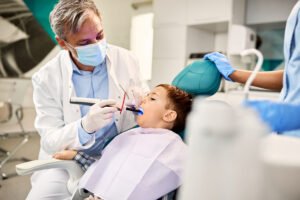
Aside from safety, my other priority is your child’s comfort. X-rays can look intimidating to a little one. The sensor can feel bulky in a small mouth. My team is trained to make this process easy and even fun.
We use “tell-show-do” techniques. We might call the camera a “spaceship” or tell the child we are taking “superhero pictures” of their teeth. We use smaller sensors designed specifically for pediatric mouths to minimize gagging or discomfort. Because digital images are instant, the whole process is over in seconds. Most children are fascinated to see their own skeleton teeth pop up on the screen!
Investing in Your Child’s Future
Living in Beverly Hills, we are surrounded by advancements in health and wellness. Incorporating safe, digital radiography into your child’s dental care is part of a holistic approach to health. Oral health is linked to overall systemic health. Infections in the mouth can affect the rest of the body, and issues with chewing can affect nutrition and growth.
By allowing us to use diagnostic imaging, you are empowering us to catch problems while they are small, manageable, and inexpensive to fix. You are saving your child from potential pain and helping them maintain a natural, healthy smile as they grow into adulthood.
Partnering for Your Child’s Health
I hope this post has helped demystify the topic of pediatric dental x-rays safety. My philosophy is built on trust and transparency. I will never recommend a procedure or an X-ray that I wouldn’t feel comfortable performing on my own family.
We are a team. When you bring your child to my office, we are working together to ensure they grow up with a healthy foundation. If you ever have specific concerns about radiation or your child’s medical history, please bring them up at your next appointment. I am always happy to sit down, look at the data with you, and adjust our care plan to make you feel comfortable.
Your child’s smile is precious, and using the best technology safely is how we keep it that way.